Lara Croft - Interrogating
The fandom is split. Purists want the cold, anti-heroic raider of tombs. Progressives want the complex, emotionally vulnerable hero of the reboots. The industry wants a middle ground that pleases investors.
This is a mature, if unintentional, critique. The modern Lara is an agent of chaos. She is a traumatized addict—addicted to danger, addicted to her father's approval, and addicted to the adrenaline of the tomb. Interrogating this iteration reveals a character who is not a power fantasy, but a cautionary tale about the cost of obsession. Interrogating Lara Croft
Born into British aristocracy, the original Lara shunned her betrothal and wealth for a life of high-stakes archaeology following a transformative plane crash in the Himalayas. The Gritty Reboot (2013): The fandom is split
For over twenty-five years, Lara Croft has been a ghost haunting the halls of digital entertainment. She is more than a protagonist; she is a Rorschach test for the video game industry itself. To some, she is a pioneer—the first lady of interactive action, a titan of puzzle-solving, and a genuine pop-cultural icon. To others, she is a problematic relic of the 1990s, a polygonally voluptuous symbol of adolescent male fantasy wrapped in cargo shorts and dual-wielding pistols. The industry wants a middle ground that pleases investors
As technology improved, so did the complexity of the character. The original five Tomb Raider games (and the disastrous sixth, The Angel of Darkness ) transformed Lara from a silent explorer into a quippy aristocrat. This was the era of "Lara, the Brand."


Call us (08:30-16:00 UK)
01803 865913International
+44 1803 865913Need Help?
Help pages
Wildlife Survey & Monitoring
- Aquatic Survey & Monitoring
- Professional Hand & Kick Nets
- Water Testing
- Waders & Aquatic Safety
- Pond Dipping Equipment
- Plant Survey
- Tree Survey Equipment
- Quadrats & Point Frames
- Botanical Presses & Accessories
- Marking Tape & Marking Flags
- Amphibian & Reptile Survey
- Amphibian Survey & Monitoring
- Reptile Survey & Monitoring
- Scales, Balances & Holding Bags
Practical Conservation Equipment
- Bird Boxes
- Woodcrete & WoodStone Bird Boxes
- Bird Boxes for Walls & Fences
- Integrated Bird Boxes
- Wooden Bird Boxes
- Bat Boxes
- Woodcrete & WoodStone Bat Boxes
- Bat Boxes for External Walls
- Integrated Bat Boxes
- Wooden Bat Boxes
- Other Nest Boxes, Habitats & Feeders
- Insect Boxes
- Mammal Boxes
- Frog & Toad Habitats
- Feeders & Water Baths
- Wildlife Management
- Badger Gates & Fencing
- Invasive Species Control
- Amphibian & Reptile Fencing
- Predator Deterrents & Repellents
Field Guides & Natural History
Academic & Professional Books
British Wildlife
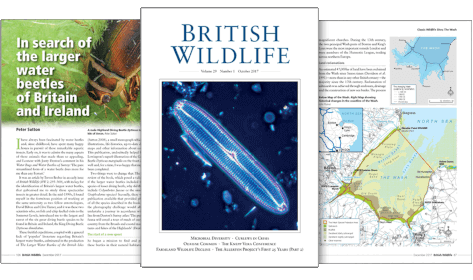
British Wildlife is the leading natural history magazine in the UK, providing essential reading for both enthusiast and professional naturalists and wildlife conservationists. Published eight times a year, British Wildlife bridges the gap between popular writing and scientific literature through a combination of long-form articles, regular columns and reports, book reviews and letters.
Conservation Land Management
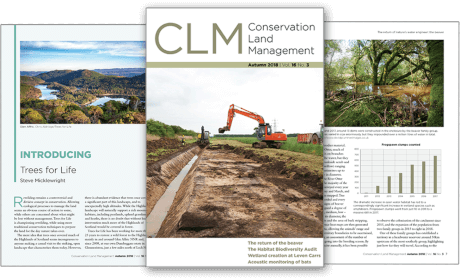
Conservation Land Management (CLM) is a quarterly magazine that is widely regarded as essential reading for all who are involved in land management for nature conservation, across the British Isles. CLM includes long-form articles, events listings, publication reviews, new product information and updates, reports of conferences and letters.